


Self-Supervised Inertial Odometry
Yuheng Qiu1,2, Yutian Chen1,2, Carlton Cort2, Weison Huang2, Shibo Zhao1,
Pieter Abbeel1,3, Rocky Duan1, Koushil Sreenath1,3, C. Karen Liu1,4, Carmelo Sferrazza1,
Junyi Geng5, Sebastian Scherer2, Guanya Shi1,2
Pieter Abbeel1,3, Rocky Duan1, Koushil Sreenath1,3, C. Karen Liu1,4, Carmelo Sferrazza1,
Junyi Geng5, Sebastian Scherer2, Guanya Shi1,2
1Amazon FAR2Carnegie Mellon University3UC Berkeley4Stanford University5Penn State University
Abstract
Learning inertial odometry for a new platform usually requires labeled trajectories. We show that an IMU integration teacher can train a velocity model from scratch without velocity or position labels. The teacher is myopic: it integrates each short window independently. The student learns from these short-window targets yet predicts long-horizon velocity changes more accurately than its teacher. Integration self-supervision draws its training signal from the input itself: over each window, the calibrated IMU samples are integrated into a velocity change, and the student's predicted velocities at the window endpoints must reproduce it. Optional pose graph distillation (PGD) then refines the student: one pose graph over many windows is solved for sequence-consistent velocities, which become fine-tuning targets for the student. A new embodiment then requires no motion capture, RTK, or SLAM ground truth, only unlabeled IMU recorded on the platform during normal operation. Across six datasets spanning pedestrians, drones, quadrupeds, and a humanoid, the same recipe applied unchanged trains inertial odometry comparable to a supervised AirIO baseline.
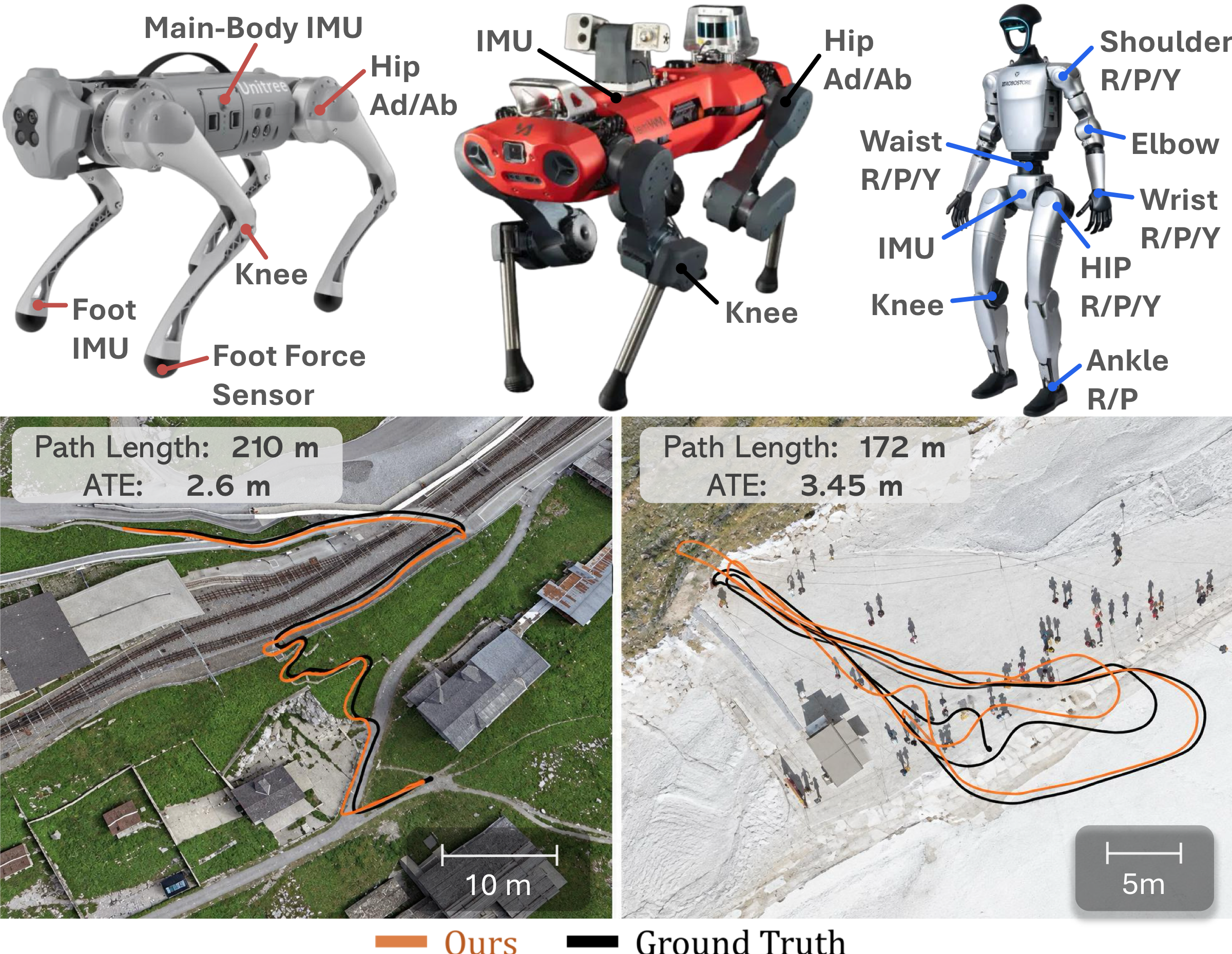
Six Datasets, One Recipe
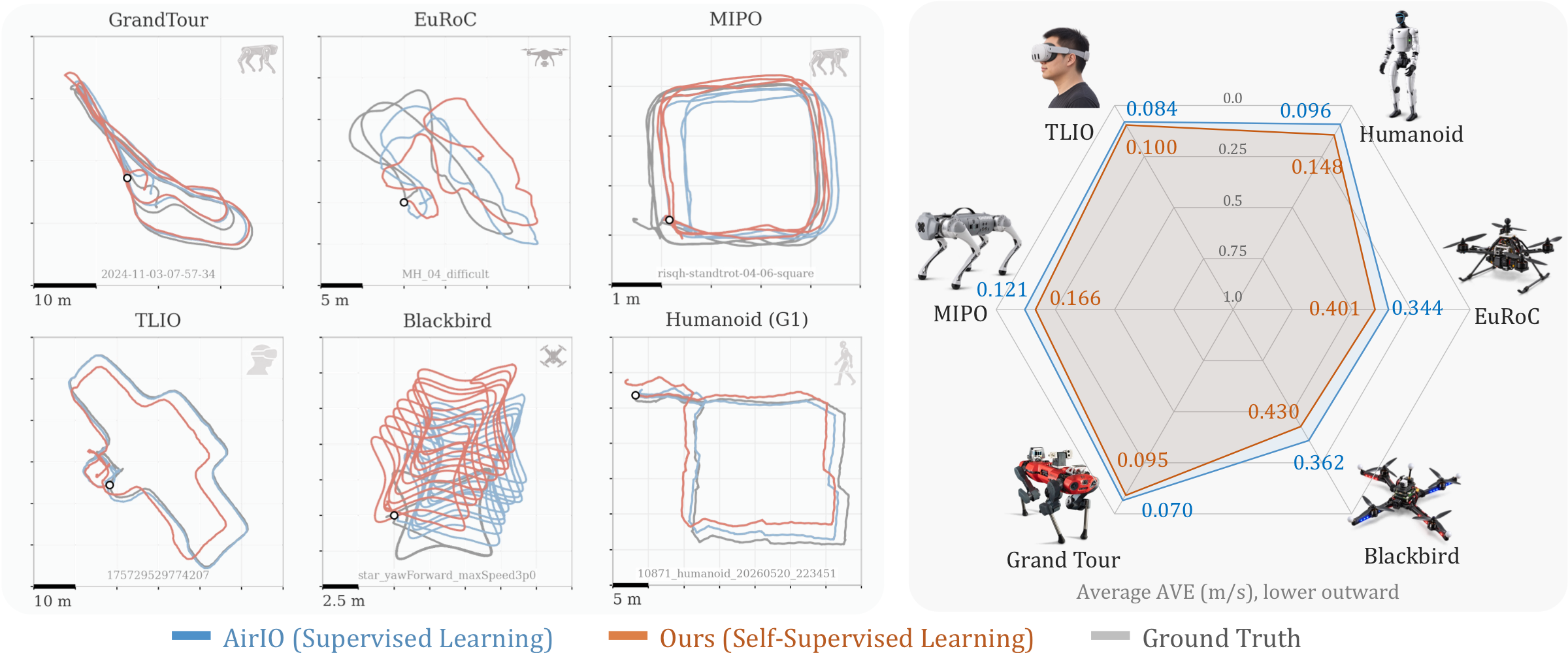
Self-Supervised Inertial Odometry on Real Robots
All models are trained from scratch with self-supervision on unlabeled data, without velocity or position labels.
GrandTour · ANYmal
MIPO · Unitree Go1
Introduction
Methods
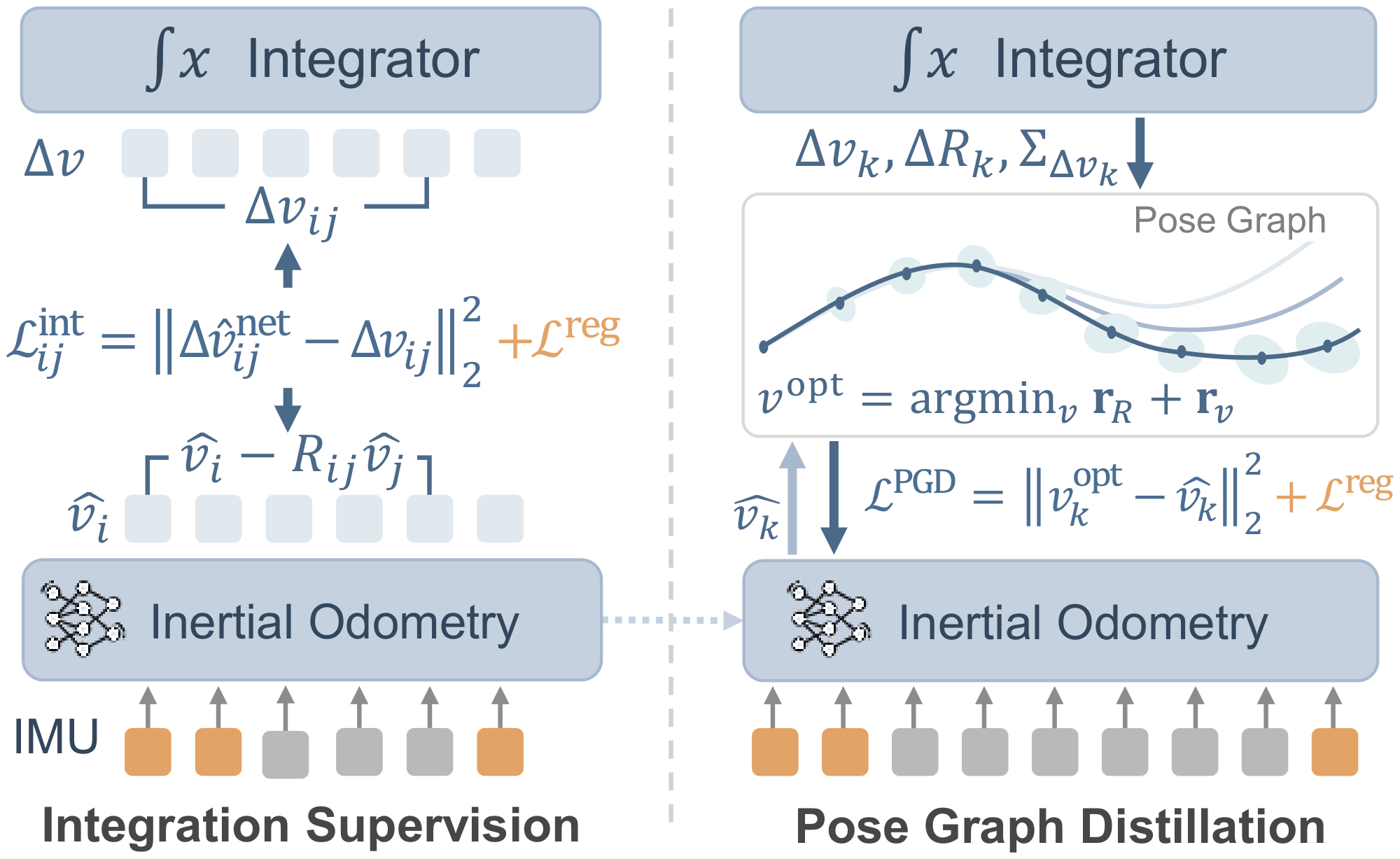
The training signal comes from the IMU input itself, not from a recorded trajectory:
- Integration self-supervision. A frozen integration teacher turns each short IMU window into a velocity change; the network's predicted velocities at the window endpoints must reproduce it.
- Pose graph distillation (PGD). One full-sequence pose graph built from the teacher's IMU factors and the network's velocity factors is solved for sequence-consistent velocities, which then supervise the network.
Proprioceptive Input
On the three articulated platforms that log proprioception, feeding joint states to the student (and, on MIPO, the four calf-mounted IMUs) lowers both velocity and trajectory error, with the teacher and loss unchanged.
Finding 1: Accuracy scales with unlabeled data
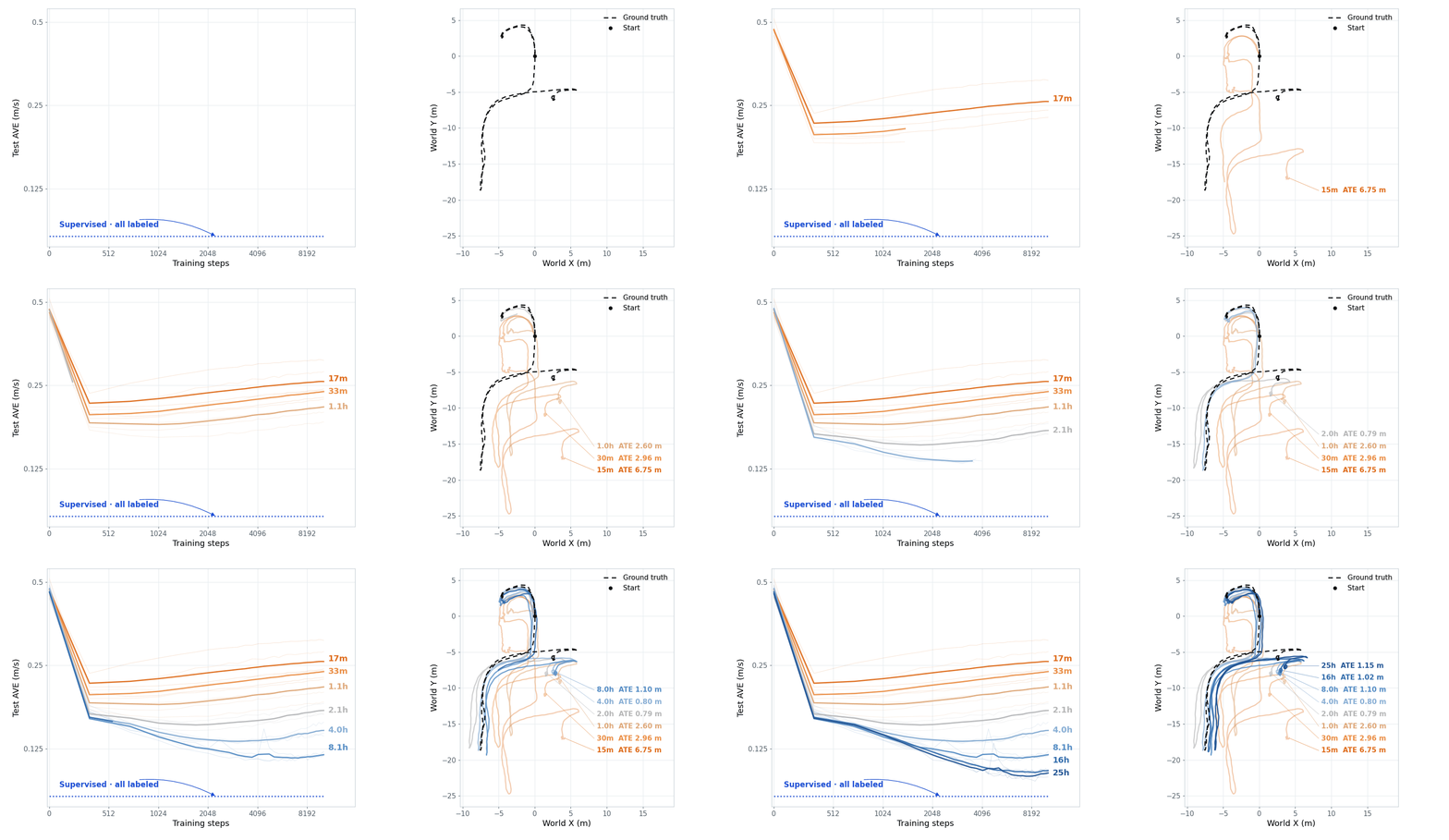
Held-out velocity error improves steadily as the unlabeled TLIO data grows from 15 minutes to 25.3 hours, approaching the supervised AirIO baseline at full scale. All eight data pools share the same step budget.
Finding 2: Learning from a myopic teacher, the student surpasses it
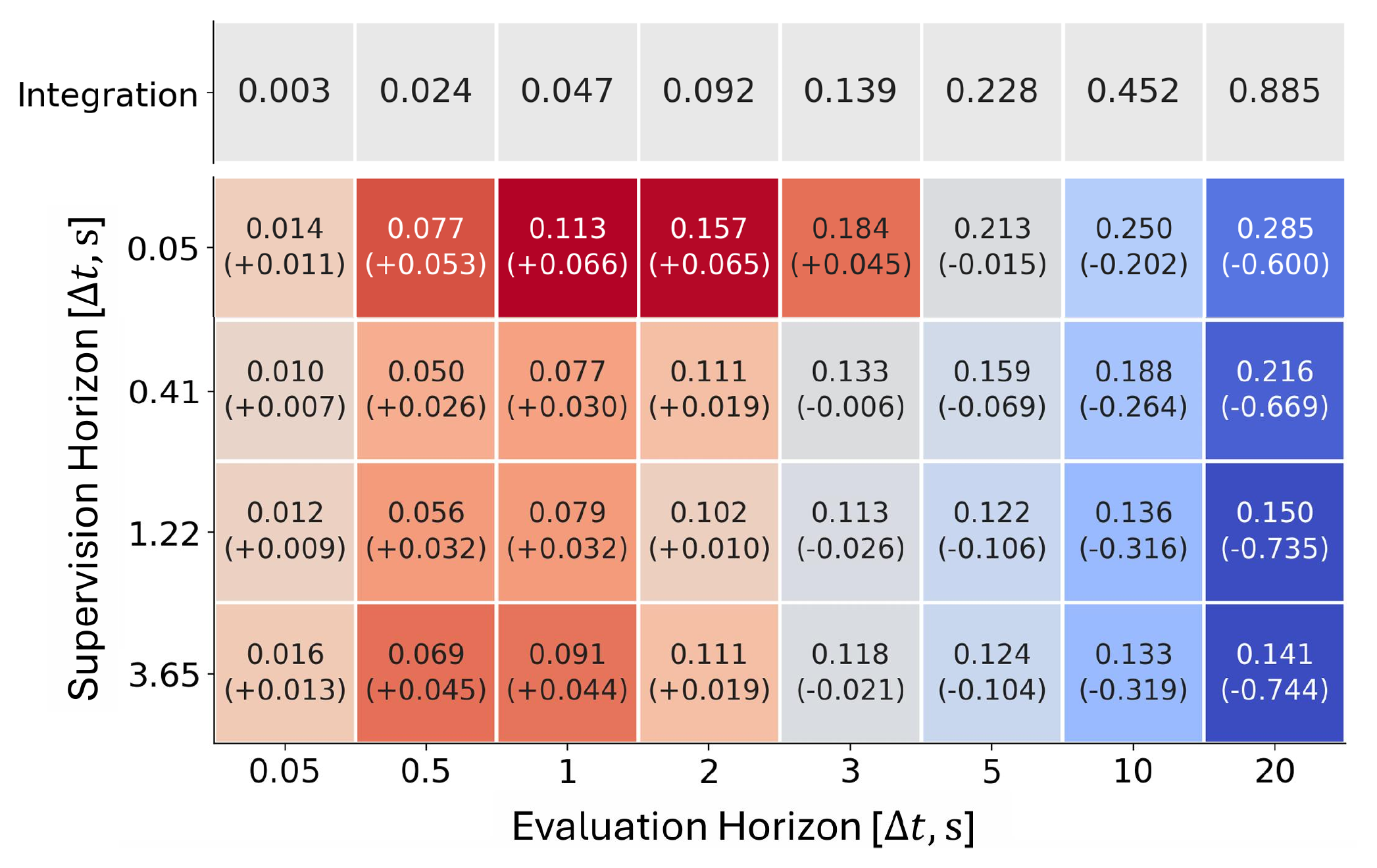
The integration teacher integrates each short IMU window independently, so its error grows with the horizon. The student only ever sees these short-window targets.
- Over short horizons the teacher is more accurate; the student's error grows far more slowly.
- At a 20 s horizon the student reaches 0.141 m/s versus the teacher's 0.885 m/s, roughly a sixfold reduction.
- Even a student supervised on 0.05 s windows beats the teacher from 5 s onward (0.285 vs 0.885 m/s at 20 s).
Note: This is an empirical observation on TLIO; the paper does not yet give a theoretical account of why the student generalizes beyond its teacher.
Trajectory Gallery
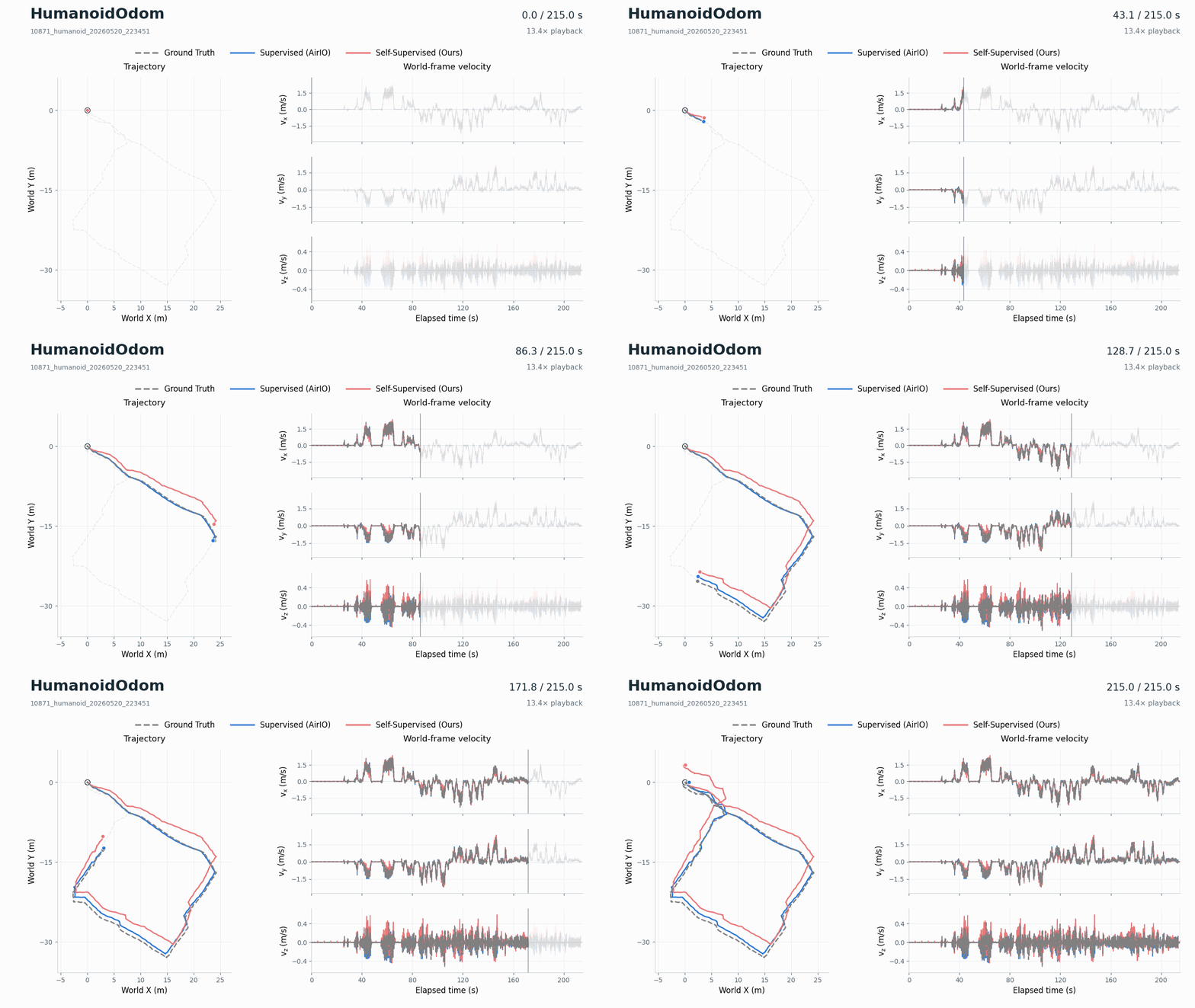
2D trajectories and velocity components compared with ground truth. Our models are trained from scratch with no velocity or position labels.
Humanoid · 10871_humanoid_20260520_223451
Citation
@article{qiu2026ssio,
      title={Self-Supervised Inertial Odometry},
      author={Yuheng Qiu and Yutian Chen and Carlton Cort and Weison Huang and Shibo Zhao and Pieter Abbeel and Rocky Duan and Koushil Sreenath and C. Karen Liu and Carmelo Sferrazza and Junyi Geng and Sebastian Scherer and Guanya Shi},
      journal={arXiv preprint arXiv:2610.25988},
      year={2026},
}